

Text
A text: titles, labels and live value readouts. Bind its text to a tag to show the value, with the unit and the number of decimals set here; a Bad value shows a dash, never the last good number. Texts are translatable with t: keys and follow the project’s text styles.
The inspector groups the rest in four sections: Font (text style, family, size, weight, bold, italic, underline, strikethrough, letter spacing, line height, letter case), Colour & effects (colour, opacity, outline, shadow), Box (auto or fixed size, alignment, padding, wrap, clip, ellipsis or shrink to fit, background, border, corner radius) and Value (unit, decimals, prefix, suffix, thousands separator, colours of a bad or uncertain value). See Format text on a screen.

| Palette | Not in the palette |
JSON type |
Text |
| Name in the inspector | Text |
| Size | a resize is stored as a scale (scaleX, scaleY); width and height keep the size it was drawn at |
Properties
Section titled “Properties”| Shown as | Key | Type | Unit | Default | Allowed values | What it does |
|---|---|---|---|---|---|---|
| Unit (shown after a bound value) | unit |
Text | — | Unit written after a bound number (degC, bar, %), whichever Bind tab target shows it: Value (Numeric), Text / Label or Display Text / Value. A word (RUNNING) or a Bad value’s dash is written without it. | ||
| Decimals shown | decimals |
Number | — | min 0, max 6, step 1 | Decimals of a bound numeric value (Value or Text / Label target). Empty: whole numbers as they are, others with 2 decimals. | |
| — | width |
Number | 140 |
Width of the text box. With a fixed box (Box section) the handles change it and the font stays; with an auto box a resize changes the font size. | ||
| — | height |
Number | 30 |
Height of the text box (see width). | ||
| — | text |
Text | "Label 1" |
The text shown. A bound value replaces it. Write t:key|Fallback for a translatable text. | ||
| — | fontSize |
Number | 16 |
Size of the text in pixels. | ||
| — | fontFamily |
Text | "Rajdhani, sans-serif" |
Font family, from the font picker. | ||
| — | fill |
Colour | "#38bdf8" |
Colour of the text. | ||
| — | label |
Text | "TEXT" |
The object’s name in the layers list. The palette places it as TEXT. | ||
| X | x |
Number | px | — | Horizontal position of the object’s top-left corner on the screen, in screen pixels from the left edge. | |
| Y | y |
Number | px | — | Vertical position of the object’s top-left corner, in screen pixels from the top edge. | |
| Rotation | rotation |
Number | ° | — | Rotation of the object, clockwise, in degrees. | |
| Opacity | opacity |
Number | — | 0 (invisible) to 1 (opaque). An object disabled by an interlock is drawn at 0.45 whatever this says. | ||
| Scale X | scaleX |
Number | — | Horizontal scale factor (1 = drawn size). Set by resizing an object that is sized by scale. | ||
| Scale Y | scaleY |
Number | — | Vertical scale factor (1 = drawn size). | ||
| States | states |
Object | — | This object’s own state styles (normal, hover, pressed, on, disabled, bad, locked, unconfigured), edited in the inspector’s States section. Visual only. Empty: the project’s state styles. | ||
| State family | styleFamily |
Text | — | The state family whose project styles apply (button, input, toggle, selector, faceplateButton, default). Empty: the family of the object’s type. |
Bindings and conditions
Section titled “Bindings and conditions”The Bind tab ties a property to a tag or an expression: a tag binding takes the tag’s value, an expression binding computes one (see the expression language), optionally through a map, format or script transform. The targets the Bind tab offers for this object:
| Bind tab target | Key | What the bound value does |
|---|---|---|
| Display Text / Value | text |
Replaces the text drawn with the value, formatted by the binding’s format. On a Text object a number is followed by the object’s unit, as with the Value target (never a word). A Bad value shows a dash. |
| Font Size (px) | fontSize |
Sets the text size from the value, in pixels (text objects). |
| Text Color | fill |
Sets the fill colour from the value (a colour text such as #22c55e, or a colour mapped by a map transform). |
| Stroke / Border Color | stroke |
Sets the outline colour from the value. |
| Opacity (0.0 - 1.0) | opacity |
Sets the opacity from the value (0 to 1). |
| Visibility (Boolean) | visible |
Shows the object when the value is true or non-zero, hides it otherwise. |
| Rotation (°) | rotation |
Rotates the object by the value, in degrees. |
| Scale / Pulse | scale |
Scales the object by the value (1 = drawn size). |
| Value (Numeric) | value |
Shows the value as the object’s readout (with the unit and decimals). A Bad value shows a dash. |
The Cond tab adds rules evaluated on every value change: Visibility (show or hide, by condition or role), Color & Fill (colour bands, alarm blinking), Position and Size & Fill (motion and level mapped from a value), Rotation (angle or continuous spin; an empty input range is 0 to 100 and empty angles are -135° to 135°, while 0 is a value), Security & Touch (the interlock: a disable condition, the role required, what happens when the interlock reads a Bad value) and Text & Value (formatted text). A condition that reads a Bad value is never applied as if the value were good: visibility shows the object marked Bad, colours go neutral grey, motion stays where it is, text shows a dash.
Actions
Section titled “Actions”Any object can carry a click or tap action (the Action tab, or Full Dialog…). A write action whose tag, value or target is missing is not configured: the inspector says so and the operator’s press does nothing (unconfigured means disabled). Navigation actions write nothing and ask no confirmation. On touch screens only a deliberate tap runs an action: a swipe or a pinch that ends on the object never does. Action types:
| Action | Key (action.type) |
What it does |
|---|---|---|
| Set tag to 1 | set_1 |
Writes 1 to the action’s tag. |
| Set tag to 0 | set_0 |
Writes 0 to the action’s tag. |
| Toggle tag value | toggle |
Writes the opposite of the tag’s LIVE value: 0 when it is not 0, 1 when it is 0. When the live value is unknown, not Good or not a number, nothing is written and the operator is told why; when it changes while the operator confirms or signs, nothing is written either. |
| Set tag to 1 on press and to 0 on release | momentary_1_0 |
Writes 1 while pressed and 0 on release (hold to run). On touch, the press counts only after the finger is held still; the release is always sent. A held press is also released when the browser window loses focus or the page is hidden, and in the designer when a drag or a resize of the object starts. |
| Set tag to 0 on press and to 1 on release | momentary_0_1 |
Writes 0 while pressed and 1 on release. Released in the same cases as the 1/0 momentary. |
| Write custom value | write_val |
Writes the number in write_value. |
| Run script | run_command |
Runs a client script with the scripting API (system.tag.write, system.nav.openPopup…). Ctrl+Space completes the API. |
| Navigate to page / screen | navigate |
Opens another screen, optionally with parameters or a parameter set. |
| Open popup screen | open_popup |
Opens a screen in a popup window: modal or not, centred, next to the object or at a fixed position, with parameters. |
| Close popup | close_popup |
Closes the popup the object is in, or the popup with the given id. |
| Open dock | open_dock |
Opens a screen docked to an edge of the runtime (top, bottom, left, right). |
| Close dock | close_dock |
Closes the dock on that edge. |
| Open or close dock | toggle_dock |
Opens or closes the dock on that edge. |
| Back | nav_back |
Goes back to the previous screen. |
| Forward | nav_forward |
Goes forward again after Back. |
| Home screen | nav_home |
Opens the project’s home screen. |
| Open downtime panel | open_downtime |
Opens the operator runtime’s Downtime panel (OEE and downtime, Pro and Enterprise), optionally on one machine (its machine id). Navigation only: nothing is written to a tag or a machine. A machine the operator may not read is not shown; where the panel is not available, a notice says so. Offered in the designer only when the licence includes OEE and downtime. |
States, text and parameters
Section titled “States, text and parameters”States. An object’s look follows its state: normal, hover, pressed, on, disabled, bad (quality), locked (role) and unconfigured. The project’s state styles (opened from an object’s States section, or from the Project manager’s Operator runtime section) give each family of objects its colours per state, and the inspector’s States section overrides them for one object (stored in props.states). States are visual only: whether an object can be operated is decided by its interlock, the user’s rights and the server.
This object belongs to the state family default (all other objects): disabled (an interlock dims it to 0.45 opacity), bad (a tag it reads is Bad) and locked (missing role) apply when the object has conditions or an action; the other states apply to objects that are operated.
Text style and fonts. Choose a project text style (Text style in the inspector of a text, button, input or alarm object) instead of fonts and sizes per object, so a change in one place restyles every screen; font settings on the object still apply on top of the style. Fonts come from the font picker: the built-in fonts and the fonts uploaded to the project. See fonts and text styles.
Languages. A text written as a key, t:pump.start|Start pump, is shown in the operator’s language, with the text after | as the fallback. Project > Translations > Make translatable turns the literal texts of your screens into keys. See translate your project.
Screen parameters. On a screen with parameters, {Name} in any text of the object (tag paths of bindings and actions, expressions, conditions, interlocks, the confirmation tag, texts) is replaced by the parameter’s value when the screen opens, so one screen serves many pieces of equipment ({Pump}/Running). See screen parameters.
Quality. When a value the object reads is Bad, not readable, Uncertain or stale, the object is marked: a red x and a grey veil (or hatching, per the project’s quality style) for Bad or no connection, a blue lock for a tag the signed-in account may not read, an amber ? for Uncertain, a dashed outline for stale. A tag that is not readable is greyed as Bad and its value is never shown as good. The lock shows only when every Bad tag of the object is not readable: a device fault keeps the red x. Each object shows one marker, for its worst state, and markers that would overlap merge into one, drawn on the largest object with the worst state of all. The marker’s tooltip lists every tag, its quality and its age. A Bad value is never drawn as a good one. See show bad and stale values.
Comments. In the studio, right-click the object and choose Add comment to start a design-review thread on it; a numbered pin marks objects with open threads (Starter, Pro and Enterprise). Pins are shown in the designer only, never in the runtime. See review screens before deploy.
Examples
Section titled “Examples”A temperature readout with its unit
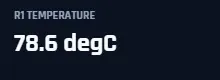
Section titled “A temperature readout with its unit”A caption and a live readout of the reactor R1 temperature, with one decimal and the unit.
- Place a Text for the caption: text
R1 TEMPERATURE, size 12, grey. - Place a second one for the value: size 26, bold.
- On its Bind tab, target Value (Numeric), type Tag, tag
Plant/Processing/Reactors/R1/Temperature. - In the inspector, Unit
degC, Decimals shown 1.
The text as saved in the screen (JSON)
{ "type": "Text", "props": { "text": "R1 TEMPERATURE", "fontSize": 12, "fontStyle": "bold", "fill": "#94a3b8", "label": "R1_TEMP_CAPTION" }}A translatable title
Section titled “A translatable title”A title written as a translation key shows the operator’s language, and the fallback text where no translation exists.
- Type the text
t:area1.title|AREA 1 - TANK FARM(or write it plainly and use Project > Translations > Make translatable). - Add the key’s translations in Project > Translations.

The text as saved in the screen (JSON)
{ "type": "Text", "props": { "text": "t:area1.title|AREA 1 - TANK FARM", "fontSize": 20, "fontStyle": "bold", "fill": "#cbd5e1", "label": "AREA1_TITLE" }}