PID controller card
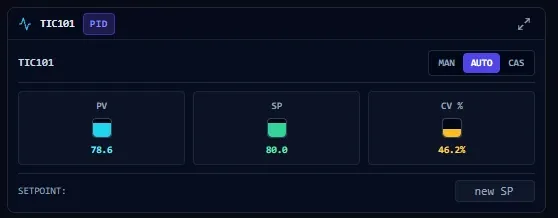
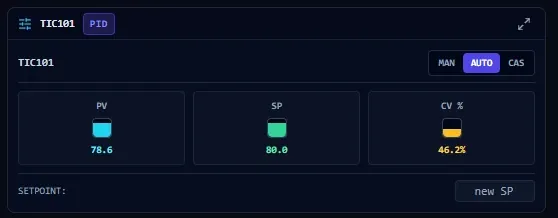
A control loop on one card: PV, setpoint and output as bars and numbers, the mode (MAN, AUTO, CAS) highlighted from the mode tag, mode buttons and a setpoint field. The values read <folder>/PV, /Setpoint, /Output and /Mode unless a tag is set for one of them.
| Card palette | Full Industrial Faceplates › ISA PID Loop Controller |
| Card kind | pid_controller (body.faceplate) |
| Default size | 6 × 3 grid cells |
Settings
Section titled “Settings”Double-click the card (or select it and press Enter) to open its settings. The settings are stored in the card’s body.params.
| Shown as | Key (body.params) |
Type | Unit | Default | Allowed values | What it does |
|---|---|---|---|---|---|---|
| Equipment name | loopName |
Text | "PID Controller" |
The loop’s name shown on the card. | ||
| Tag folder | tagPrefix |
Tag path (read) | "" |
The folder holding the equipment’s tags (Plant/Processing/Pumps/P101). Each value reads <folder>/<signal> exactly, unless a tag is set for that signal. Settings hint: The folder holding this equipment’s tags, e.g. Area/Equipment. Each value below reads <folder>/<name> exactly, unless a tag is set for it. | ||
| PV tag (optional) | pvTag |
Tag path (read) | — | The process value tag. Empty: <folder>/PV. Settings hint: Empty = <folder>/PV. | ||
| Setpoint tag (optional) | setpointTag |
Tag path (read) | — | The setpoint tag: read, and written by the setpoint field. Empty: <folder>/Setpoint. Settings hint: Empty = <folder>/Setpoint. | ||
| Output tag (optional) | cvTag |
Tag path (read) | — | The controller output tag. Empty: <folder>/Output. Settings hint: Empty = <folder>/Output. | ||
| Mode tag (optional) | modeTag |
Tag path (read) | — | The mode tag (0 MAN, 1 AUTO, 2 CAS): read, and written by the mode buttons. Empty: <folder>/Mode. Settings hint: Empty = <folder>/Mode. | ||
| Confirmation | confirmation |
Choice | "none" |
nonerequireesignature |
What a mode button and the setpoint field ask before they write: none; require, a confirmation dialog; esignature, the signed-in user’s password (the signer is shown read-only, the password field starts empty). The server requires the same for the mode and setpoint tags from every client. Settings hint: none: the command is sent when pressed; require: a confirmation dialog first; esignature: the signed-in user signs with their password. The server requires the same for these tags from every client. | |
| Interlock tag (optional) | interlockTag |
Tag path (read) | "" |
A tag that disables the mode buttons and the setpoint field while it is not 0, has no value or a Bad value (an INTERLOCKED chip is shown). The server refuses their writes while the interlock is active. Empty: no interlock. Settings hint: While this tag is not 0, or has no value or a Bad value, the card’s commands are disabled and the server refuses them. Empty: no interlock. | ||
| Setpoint minimum | spMin |
Number | — | Lowest setpoint the field sends. Not in the settings dialog: set it in the card’s JSON. The server’s limits on the tag apply in any case. | ||
| Setpoint maximum | spMax |
Number | — | Highest setpoint the field sends (card JSON). |
Actions
Section titled “Actions”A mode button writes the mode’s number (0, 1 or 2) to the mode tag; the buttons are highlighted from the mode tag’s value, not from the click. The setpoint field writes the number typed to the setpoint tag, refused before sending when it is not a number or is outside spMin / spMax. Both ask the card’s confirmation or electronic signature first when one is set, and send nothing while its interlock is active. The tag’s own write policy applies as well: the strictest wins.
Commands. The card writes to tags only in the live operator view, never in Edit layout, and only through the guarded write path: the server checks the user’s rights, the tag’s write range and the confirmation or electronic signature the tag requires, and the card reports the server’s answer (a refused write is never shown as done). A card without its tag cannot send anything.
Quality and parameters
Section titled “Quality and parameters”Values come with their quality: a Bad or Uncertain value is marked on the card, and a value not yet received shows a dash, never an invented number. A card on a screen with parameters takes {Name} in its tag paths.
Examples
Section titled “Examples”Loop TIC101 with setpoint limits
Section titled “Loop TIC101 with setpoint limits”The card for TIC101, its setpoint field limited to 20 to 110 degC. Give the setpoint tag a write range as well: the server then refuses an out-of-range setpoint from every writer.
- Add the card; Tag folder
Plant/Processing/Loops/TIC101, Equipment nameTIC101. - In the card’s JSON,
spMin: 20 andspMax: 110. - On the tag
Plant/Processing/Loops/TIC101/Setpoint, set its write range (min 20, max 110) in eaxTags or the tag mapping.