

Process symbol
One object for a library of process symbols: vessels and columns, pumps, compressors, fans and turbines, heat transfer, material handling, separation, electrical one-line and piping accessories. The Symbol property picks the drawing; each symbol has its own proportions and is scaled into the object’s box. The palette groups (Vessels & Tanks, Pumps, Compressors & Fans…) place each symbol with a thumbnail; the full list is in the P&ID palette catalog.
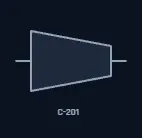
| Palette | Not in the palette |
JSON type |
ProcessSymbol |
| Name in the inspector | Symbol |
| Size | drawn from width and height; a resize changes them |
Properties
Section titled “Properties”| Shown as | Key | Type | Unit | Default | Allowed values | What it does |
|---|---|---|---|---|---|---|
| Symbol | symbol |
Choice | "vessel_horizontal" |
vessel_horizontal Horizontal Vesselvessel_sphere Spherical Tankvessel_silo Silo / Hoppercolumn Column / Towerseparator Separator / KO Drumvessel_jacketed Jacketed Vesselmixer Agitator / Mixerpump_gear Gear Pumppump_screw Screw Pumppump_peristaltic Peristaltic Pumppump_submersible Submersible Pumppump_dosing Dosing / Metering Pumpcompressor Compressorcompressor_recip Reciprocating Compressorblower Blowerfan Fanturbine Turbinecooling_tower Cooling Towerfired_heater Fired Heatercondenser Condenserscrew_conveyor Screw Conveyorbucket_elevator Bucket Elevatorrotary_valve Rotary Valve / Airlockweigh_feeder Weigh Feederdiverter Diverter Gatefilter Filterstrainer Strainercyclone Cyclonecentrifuge Centrifugedryer Rotary Dryerbreaker Circuit Breakercontactor Contactorvfd VFD / Drivetransformer Transformerbusbar Busbarmcc MCC Bucketdisconnect Disconnect Switchgenerator Generatormotor_elec Motor (one-line)reducer Reducerelbow Elbow 90°tee Teeflange_pair Flange Pairexpansion_joint Expansion Jointsight_glass Sight Glasssteam_trap Steam Traporifice_plate Orifice Plate |
The symbol drawn. | |
| — | width |
Number | 100 |
Width of the box the symbol is scaled into. | ||
| — | height |
Number | 100 |
Height of the box the symbol is scaled into (the palette adds 16 pixels for the caption). | ||
| — | label |
Text | — | The equipment tag drawn under the symbol (C-201). | ||
| — | fill |
Colour | "#1e293b" |
Fill colour of the symbol. | ||
| — | stroke |
Colour | "#94a3b8" |
Line colour of the symbol. | ||
| Stroke width | strokeWidth |
Number | px | 2 |
Outline thickness in pixels; 0 draws no outline. | |
| X | x |
Number | px | — | Horizontal position of the object’s top-left corner on the screen, in screen pixels from the left edge. | |
| Y | y |
Number | px | — | Vertical position of the object’s top-left corner, in screen pixels from the top edge. | |
| Rotation | rotation |
Number | ° | — | Rotation of the object, clockwise, in degrees. | |
| Opacity | opacity |
Number | — | 0 (invisible) to 1 (opaque). An object disabled by an interlock is drawn at 0.45 whatever this says. | ||
| States | states |
Object | — | This object’s own state styles (normal, hover, pressed, on, disabled, bad, locked, unconfigured), edited in the inspector’s States section. Visual only. Empty: the project’s state styles. | ||
| State family | styleFamily |
Text | — | The state family whose project styles apply (button, input, toggle, selector, faceplateButton, default). Empty: the family of the object’s type. |
A process symbol colours like any shape: a Color & Fill condition on its stroke or fill shows running, stopped or fault. It has no live value of its own: put a text or a gauge next to it.
Bindings and conditions
Section titled “Bindings and conditions”The Bind tab ties a property to a tag or an expression: a tag binding takes the tag’s value, an expression binding computes one (see the expression language), optionally through a map, format or script transform. The targets the Bind tab offers for this object:
| Bind tab target | Key | What the bound value does |
|---|---|---|
| Fill Color | fill |
Sets the fill colour from the value (a colour text such as #22c55e, or a colour mapped by a map transform). |
| Stroke / Border Color | stroke |
Sets the outline colour from the value. |
| Opacity (0.0 - 1.0) | opacity |
Sets the opacity from the value (0 to 1). |
| Visibility (Boolean) | visible |
Shows the object when the value is true or non-zero, hides it otherwise. |
| Rotation (°) | rotation |
Rotates the object by the value, in degrees. |
| Scale / Pulse | scale |
Scales the object by the value (1 = drawn size). |
| Text / Label | text |
Replaces the text drawn with the value, formatted by the binding’s format. On a Text object a number is followed by the object’s unit, as with the Value target (never a word). A Bad value shows a dash. |
| Value (Numeric) | value |
Shows the value as the object’s readout (with the unit and decimals). A Bad value shows a dash. |
The Cond tab adds rules evaluated on every value change: Visibility (show or hide, by condition or role), Color & Fill (colour bands, alarm blinking), Position and Size & Fill (motion and level mapped from a value), Rotation (angle or continuous spin; an empty input range is 0 to 100 and empty angles are -135° to 135°, while 0 is a value), Security & Touch (the interlock: a disable condition, the role required, what happens when the interlock reads a Bad value) and Text & Value (formatted text). A condition that reads a Bad value is never applied as if the value were good: visibility shows the object marked Bad, colours go neutral grey, motion stays where it is, text shows a dash.
Actions
Section titled “Actions”Any object can carry a click or tap action (the Action tab, or Full Dialog…). A write action whose tag, value or target is missing is not configured: the inspector says so and the operator’s press does nothing (unconfigured means disabled). Navigation actions write nothing and ask no confirmation. On touch screens only a deliberate tap runs an action: a swipe or a pinch that ends on the object never does. Action types:
| Action | Key (action.type) |
What it does |
|---|---|---|
| Set tag to 1 | set_1 |
Writes 1 to the action’s tag. |
| Set tag to 0 | set_0 |
Writes 0 to the action’s tag. |
| Toggle tag value | toggle |
Writes the opposite of the tag’s LIVE value: 0 when it is not 0, 1 when it is 0. When the live value is unknown, not Good or not a number, nothing is written and the operator is told why; when it changes while the operator confirms or signs, nothing is written either. |
| Set tag to 1 on press and to 0 on release | momentary_1_0 |
Writes 1 while pressed and 0 on release (hold to run). On touch, the press counts only after the finger is held still; the release is always sent. A held press is also released when the browser window loses focus or the page is hidden, and in the designer when a drag or a resize of the object starts. |
| Set tag to 0 on press and to 1 on release | momentary_0_1 |
Writes 0 while pressed and 1 on release. Released in the same cases as the 1/0 momentary. |
| Write custom value | write_val |
Writes the number in write_value. |
| Run script | run_command |
Runs a client script with the scripting API (system.tag.write, system.nav.openPopup…). Ctrl+Space completes the API. |
| Navigate to page / screen | navigate |
Opens another screen, optionally with parameters or a parameter set. |
| Open popup screen | open_popup |
Opens a screen in a popup window: modal or not, centred, next to the object or at a fixed position, with parameters. |
| Close popup | close_popup |
Closes the popup the object is in, or the popup with the given id. |
| Open dock | open_dock |
Opens a screen docked to an edge of the runtime (top, bottom, left, right). |
| Close dock | close_dock |
Closes the dock on that edge. |
| Open or close dock | toggle_dock |
Opens or closes the dock on that edge. |
| Back | nav_back |
Goes back to the previous screen. |
| Forward | nav_forward |
Goes forward again after Back. |
| Home screen | nav_home |
Opens the project’s home screen. |
| Open downtime panel | open_downtime |
Opens the operator runtime’s Downtime panel (OEE and downtime, Pro and Enterprise), optionally on one machine (its machine id). Navigation only: nothing is written to a tag or a machine. A machine the operator may not read is not shown; where the panel is not available, a notice says so. Offered in the designer only when the licence includes OEE and downtime. |
States, text and parameters
Section titled “States, text and parameters”States. An object’s look follows its state: normal, hover, pressed, on, disabled, bad (quality), locked (role) and unconfigured. The project’s state styles (opened from an object’s States section, or from the Project manager’s Operator runtime section) give each family of objects its colours per state, and the inspector’s States section overrides them for one object (stored in props.states). States are visual only: whether an object can be operated is decided by its interlock, the user’s rights and the server.
This object belongs to the state family default (all other objects): disabled (an interlock dims it to 0.45 opacity), bad (a tag it reads is Bad) and locked (missing role) apply when the object has conditions or an action; the other states apply to objects that are operated.
Screen parameters. On a screen with parameters, {Name} in any text of the object (tag paths of bindings and actions, expressions, conditions, interlocks, the confirmation tag, texts) is replaced by the parameter’s value when the screen opens, so one screen serves many pieces of equipment ({Pump}/Running). See screen parameters.
Quality. When a value the object reads is Bad, not readable, Uncertain or stale, the object is marked: a red x and a grey veil (or hatching, per the project’s quality style) for Bad or no connection, a blue lock for a tag the signed-in account may not read, an amber ? for Uncertain, a dashed outline for stale. A tag that is not readable is greyed as Bad and its value is never shown as good. The lock shows only when every Bad tag of the object is not readable: a device fault keeps the red x. Each object shows one marker, for its worst state, and markers that would overlap merge into one, drawn on the largest object with the worst state of all. The marker’s tooltip lists every tag, its quality and its age. A Bad value is never drawn as a good one. See show bad and stale values.
Comments. In the studio, right-click the object and choose Add comment to start a design-review thread on it; a numbered pin marks objects with open threads (Starter, Pro and Enterprise). Pins are shown in the designer only, never in the runtime. See review screens before deploy.
Examples
Section titled “Examples”A few symbols of the library
Section titled “A few symbols of the library”A column, a cyclone, a cooling tower, a rotary valve, a transformer and a breaker, each placed from its palette group and labelled.
- Open the symbol groups of the palette: Vessels & Tanks, Separation, Heat Transfer, Material Handling, Electrical One-Line.
- Click a symbol, then click on the canvas; set the label in the inspector.
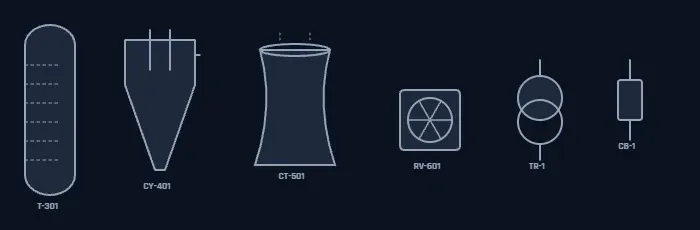
The process symbol as saved in the screen (JSON)
{ "type": "ProcessSymbol", "props": { "symbol": "column", "fill": "#1e293b", "stroke": "#94a3b8", "strokeWidth": 2, "label": "T-301" }}A compressor coloured by its state
Section titled “A compressor coloured by its state”Compressor C-201’s outline turns green while motor M101 (its drive) runs, with a discrete colour condition on the stroke.
- Place Compressor from Pumps, Compressors & Fans; label
C-201. - Cond tab, Color & Fill, target Stroke, mode Discrete, expression
tag('Plant/Processing/Motors/M101/Running'):0#94a3b8,1#22c55e.
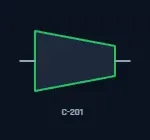
The process symbol as saved in the screen (JSON)
{ "type": "ProcessSymbol", "props": { "symbol": "compressor", "fill": "#1e293b", "stroke": "#94a3b8", "strokeWidth": 2, "label": "C-201" }, "conditions": { "color": { "enabled": true, "mode": "discrete", "expression": "tag('Plant/Processing/Motors/M101/Running')", "target": "stroke", "discreteMap": { "0": "#94a3b8", "1": "#22c55e" } } }}